Time calculation in Narsing Puran and Padm Puran and Srimad Bhagvatum
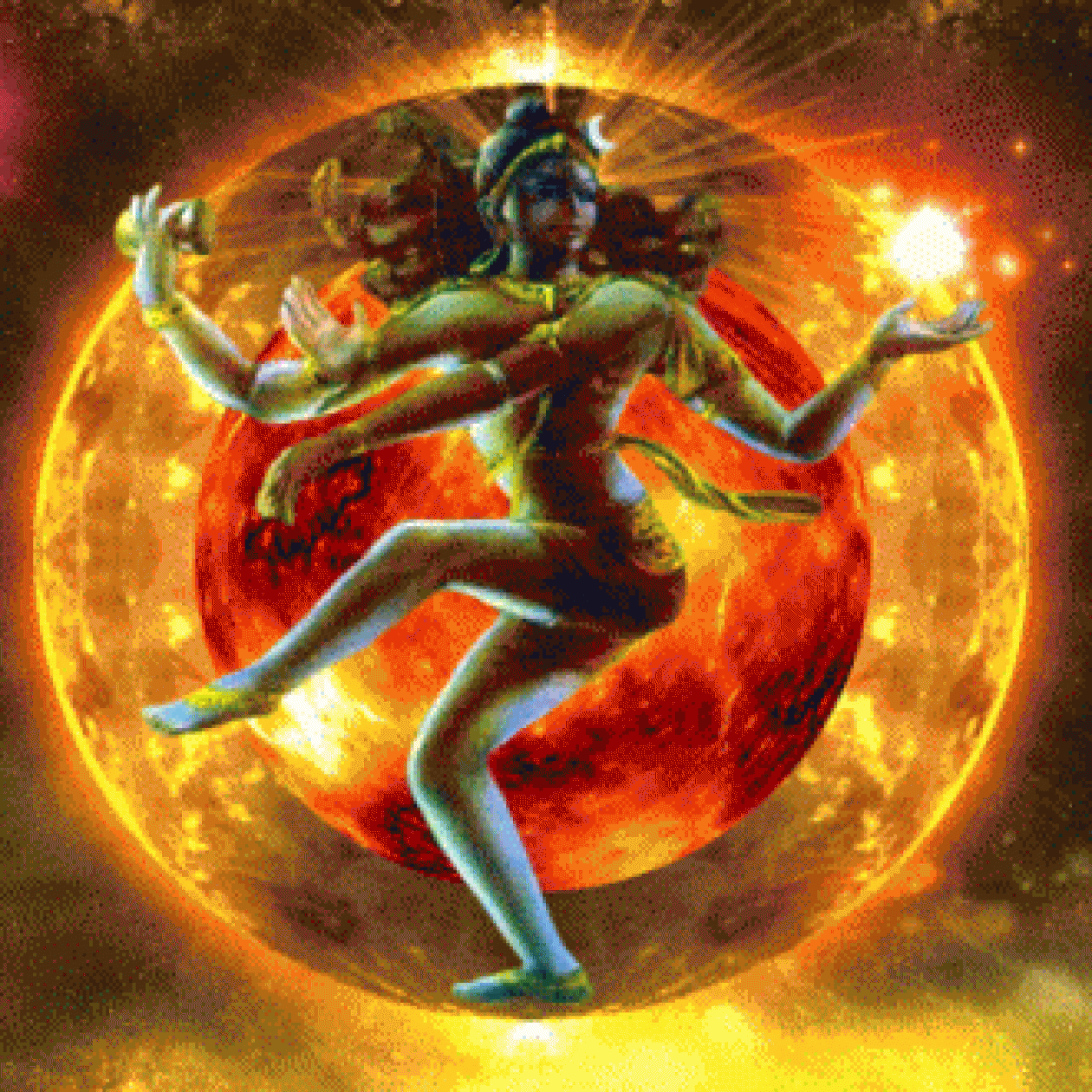
Describing the time (Kala), Vayudeva told the sages that ‘Kala’ or time is the radiance of lord Shiva. Kala or time is also known as ‘Kalatma’. The time flows smoothly without being disturbed.
Time is under the control of lord Shiva. Since the time contains the element of Shiva (Shivattatva), hence its momentum can not be checked by any other power, except that of Shiva. One, who understands the meaning of Kala, has a darshan of lord Shiva.
The smallest unit for measuring the time is called ‘Nimesh’. The time taken to drop one’s eyelid is called one Nimesh. A kala consists of fifteen Nimeshas and thirty Kalas make a ‘Muhurta’.
A day and a night consist of thirty ‘Muhurtas’. A month consists of thirty days, divided into two fortnights. One fortnight is known as ‘Krishna Paksha (dark lunar phase) and the other is known as Shukla Paksha (bright lunar phase).
In Pitarloka the day consists of one fortnight and night of the same number of days. Shukla Paksha is the day of the Pitraloka and Krishna Paksha is the night.
One ‘Ayana’ consists of Six months. A year consists of two ‘Ayanas’. One year of the earth is equivalent to a day and a night of the deities. The six months when the Sun is in the southern hemisphere of the earth, is actually the time when the deities experience night. On the contrary, the six months when sun is in the northern hemisphere is the daytime of the deities. One year of the deities is equivalent to three hundred and sixty years of this world.
The yugas are counted based on the years of the deities. According to the scholars, there are four yugas – Satya Yuga, Treta Yuga, Dwapar Yuga, and Kali Yuga.
A Satya Yuga is equivalent to four thousand years of the deities.
A Treta Yuga is equivalent to three thousand years of the deities.
Similarly, a Dwapar Yuga is equivalent to two thousand years of the deities and a Kali Yuga to that of one thousand years of the deities.
This way all four yugas collectively are equivalent to twelve thousand years of the deities.
A Kalpa consists of one thousand Chaturyugas. A Manvantar consists of seventy one Chaturyugas.
One Kalpa is inhibited by fourteen Manus one after another in succession.
A Brahma’s day is equivalent to one divine Kalpa. A Brahma’s year is equivalent to one thousand Kalpas. A Brahma’s yuga consists of eight thousand such years.
A Brahma’s ‘Savan’ consists of his one thousand yugas. Brahma’s life span is complete after three thousand such Sawanas. Five lakh and forty thousand numbers of Indras succeed one after another during the whole life span of Brahma.
A Vishnu day is equivalent to the whole life span of Brahma. The whole life span of Vishnu is equivalent to a day of ‘Rudra’. The whole life span of Rudra is equivalent to a day of lord Shiva. In the whole life of lord Shiva five lakh and four thousand numbers of Rudras come and go.
A Shiva’s day commences with the creation and before the end of the night the whole creation gets annihilated. Sadashiva is eternal.
O’ Bharadwaja! Let me tell you how Narasimha became Brahma and became engaged in the activity of the creation of the world.
O vidvan! It is said, with utmost devotion, that the paternal grandfather of the world, known by the name Narayana, just came to be utpaannah.
In his own reckoning, his life span is for one hundred years. This is called ‘para’. Half of that is parardha.
O sinless one, I told you about the time form of Sri Maha Vishnu, by which you can know how time measurements of all other beings are explained.
1 Nimisha = Is defined as the time taken to blink an eye
18 Nimishas = 1 Kasta
30 Kastas = 1 Kaala
3 Kaalas = 1 Muhurtam
30 Muhurtas = 1 Ahooratra (day and night)
If we take day and night to be approximately 24 hours,
1 Muhurtam = 48 minutes
1 Kaala = 16 min
1 Kasta = 32 secs
1 Nimisha = 1.8 secs.
30 Ahooratras = 1 Maasa (1 month)
Each Maasa has two Pakshas of 15 Ahooratras each.
6 Maasas = 1 Aayana viz., Dakshina Aayana and Uttara Aayana
The Dakshina Aayana is the night of the devas and the Uttara Aayana is the day of the devas.
2 Aayanas = 1 Varsha
1 Maasa = 1 Ahooratra of the Pitras
1 Vatsara of Humans = 1 Ahooratra of the Vasus and others. Is is also called as a divine day and night.
1 divine year = 360 Human years.
1000 divine Varshas = 1 Yuga
12000 divine years = 1 Chaturyugam or also called as 1 Maha Yugam.
1 Chaturyugam consists of the following
- 4000 divine years, plus a 400 years before and after it is Satya Yuga or also called as Kruta Yuga that is (4000+400+400)*360 = 1728000 Human Years
- 3000 divine years, plus a 300 years before and after it is Tretaa Yuga that is (3000+300+300)*360 = 1296000 Human Years
- 2000 divine years, plus a 200 years before and after is Dvaapara Yuga that is (2000+200+200)*360 = 864000 Human Years
- 1000 divine years, plus a 100 years before and after is Kali Yuga that is (1000+100+100)*360 = 432000 Human Years
A Chaturyugam has Kruta Yuga, Tretaa Yuga, Dvaapara Yuga and Kali Yuga. A thousand Chaturyugams is equal to 1 day of Brahma.
There are 14 Manus in a day of brahma.
The Saptarshis, Manus and Devas (Shakra and others) are destroyed at the same time.
71 and more caturyugas form a Manvantara, the period of the Saptarshis, Manus and Devas.
Calculation of Time, from the Atom
Srimad-Bhagavatam: Canto 3: “The Status Quo” : SB 3.11: Calculation of Time, from the Atom
Chapter Eleven
Calculation of Time, from the Atom
TEXT 1
TEXT
maitreya uvaca
caramah sad-visesanam
aneko ‘samyutah sada
paramanuh sa vijneyo
nrnam aikya-bhramo yatah
SYNONYMS
maitreyah uvaca–Maitreya said; caramah–ultimate; sat–effect; visesanam–symptoms; anekah–innumerable; asamyutah–unmixed; sada–always; parama-anuh–atoms; sah–that; vijneyah–should be understood; nrnam–of men; aikya–oneness; bhramah–mistaken; yatah–from which.
TRANSLATION
The material manifestation’s ultimate particle, which is indivisible and not formed into a body, is called the atom. It exists always as an invisible identity, even after the dissolution of all forms. The material body is but a combination of such atoms, but it is misunderstood by the common man.
PURPORT
The atomic description of the Srimad-Bhagavatam is almost the same as the modern science of atomism, and this is further described in the Paramanu-vada of Kanada. In modern science also, the atom is accepted as the ultimate indivisible particle of which the universe is composed. Srimad-Bhagavatam is the full text of all descriptions of knowledge, including the theory of atomism. The atom is the minute subtle form of eternal time.
TEXT 2
TEXT
sata eva padarthasya
svarupavasthitasya yat
kaivalyam parama-mahan
aviseso nirantarah
SYNONYMS
satah–of the effective manifestation; eva–certainly; pada-arthasya–of physical bodies; svarupa-avasthitasya–staying in the same form even to the time of dissolution; yat–that which; kaivalyam–oneness; parama–the supreme; mahan–unlimited; avisesah–forms; nirantarah–eternally.
TRANSLATION
Atoms are the ultimate state of the manifest universe. When they stay in their own forms without forming different bodies, they are called the unlimited oneness. There are certainly different bodies in physical forms, but the atoms themselves form the complete manifestation.
TEXT 3
TEXT
evam kalo ‘py anumitah
sauksmye sthaulye ca sattama
samsthana-bhuktya bhagavan
avyakto vyakta-bhug vibhuh
SYNONYMS
evam–thus; kalah–time; api–also; anumitah–measured; sauksmye–in the subtle; sthaulye–in the gross forms; ca–also; sattama–O best; samsthana–combinations of the atoms; bhuktya–by the motion; bhagavan–the Supreme Personality of Godhead; avyaktah–unmanifested; vyakta-bhuk–controlling all physical movement; vibhuh–the great potential.
TRANSLATION
One can estimate time by measuring the movement of the atomic combination of bodies. Time is the potency of the almighty Personality of Godhead, Hari, who controls all physical movement although He is not visible in the physical world.
TEXT 4
TEXT
sa kalah paramanur vai
yo bhunkte paramanutam
sato ‘visesa-bhug yas tu
sa kalah paramo mahan
SYNONYMS
sah–that; kalah–eternal time; parama-anuh–atomic; vai–certainly; yah–which; bhunkte–passes through; parama-anutam–the space of an atom; satah–of the entire aggregate; avisesa-bhuk–passing through the nondual exhibition; yah tu–which; sah–that; kalah–time; paramah–the supreme; mahan–the great.
TRANSLATION
Atomic time is measured according to its covering a particular atomic space. That time which covers the unmanifest aggregate of atoms is called the great time.
PURPORT
Time and space are two correlative terms. Time is measured in terms of its covering a certain space of atoms. Standard time is calculated in terms of the movement of the sun. The time covered by the sun in passing over an atom is calculated as atomic time. The greatest time of all covers the entire existence of the nondual manifestation. All the planets rotate and cover space, and space is calculated in terms of atoms. Each planet has its particular orbit for rotating, in which it moves without deviation, and similarly the sun has its orbit. The complete calculation of the time of creation, maintenance and dissolution, measured in terms of the circulation of the total planetary systems until the end of creation, is known as the supreme kala.
TEXT 5
TEXT
anur dvau paramanu syat
trasarenus trayah smrtah
jalarka-rasmy-avagatah
kham evanupatann agat
SYNONYMS
anuh–double atom; dvau–two; parama-anu–atoms; syat–become; trasarenuh–hexatom; trayah–three; smrtah–considered; jala-arka–of sunshine through the holes of a window screen; rasmi–by the rays; avagatah–can be known; kham eva–towards the sky; anupatan agat–going up.
TRANSLATION
The division of gross time is calculated as follows: two atoms make one double atom, and three double atoms make one hexatom. This hexatom is visible in the sunshine which enters through the holes of a window screen. One can clearly see that the hexatom goes up towards the sky.
PURPORT
The atom is described as an invisible particle, but when six such atoms combine together, they are called a trasarenu, and this is visible in the sunshine pouring through the holes of a window screen.
TEXT 6
TEXT
trasarenu-trikam bhunkte
yah kalah sa trutih smrtah
sata-bhagas tu vedhah syat
tais tribhis tu lavah smrtah
SYNONYMS
trasarenu-trikam–combination of three hexatoms; bhunkte–as they take time to integrate; yah–that which; kalah–duration of time; sah–that; trutih–by the name truti; smrtah–is called; sata-bhagah–one hundred trutis; tu–but; vedhah–called a vedha; syat–it so happens; taih–by them; tribhih–three times; tu–but; lavah–lava; smrtah–so called.
TRANSLATION
The time duration needed for the integration of three trasarenus is called a truti, and one hundred trutis make one vedha. Three vedhas make one lava.
PURPORT
It is calculated that if a second is divided into 1687.5 parts, each part is the duration of a truti, which is the time occupied in the integration of eighteen atomic particles. Such a combination of atoms into different bodies creates the calculation of material time. The sun is the central point for calculating all different durations.
TEXT 7
TEXT
nimesas tri-lavo jneya
amnatas te trayah ksanah
ksanan panca viduh kastham
laghu ta dasa panca ca
SYNONYMS
nimesah–the duration of time called a nimesa; tri-lavah–the duration of three lavas; jneyah–is to be known; amnatah–it is so called; te–they; trayah–three; ksanah–the duration of time called a ksana; ksanan–such ksanas; panca–five; viduh–one should understand; kastham–the duration of time called a kastha; laghu–the duration of time called a laghu; tah–those; dasa panca–fifteen; ca–also.
TRANSLATION
The duration of time of three lavas is equal to one nimesa, the combination of three nimesas makes one ksana, five ksanas combined together make one kastha, and fifteen kasthas make one laghu.
PURPORT
By calculation it is found that one laghu is equal to two minutes. The atomic calculation of time in terms of Vedic wisdom may be converted into present time with this understanding.
TEXT 8
TEXT
laghuni vai samamnata
dasa panca ca nadika
te dve muhurtah praharah
sad yamah sapta va nrnam
SYNONYMS
laghuni–such laghus (each of two minutes); vai–exactly; samamnata–is called; dasa panca–fifteen; ca–also; nadika–a nadika; te–of them; dve–two; muhurtah–a moment; praharah–three hours; sat–six; yamah–one fourth of a day or night; sapta–seven; va–or; nrnam–of human calculation.
TRANSLATION
Fifteen laghus make one nadika, which is also called a danda. Two dandas make one muhurta, and six or seven dandas make one fourth of a day or night, according to human calculation.
TEXT 9
TEXT
dvadasardha-palonmanam
caturbhis catur-angulaih
svarna-masaih krta-cchidram
yavat prastha-jala-plutam
SYNONYMS
dvadasa-ardha–six; pala–of the scale of weight; unmanam–measuring pot; caturbhih–by weight of four; catuh-angulaih–four fingers by measure; svarna–of gold; masaih–of the weight; krta-chidram–making a hole; yavat–as long as; prastha–measuring one prastha; jala-plutam–filled by water.
TRANSLATION
The measuring pot for one nadika, or danda, can be prepared with a six-pala-weight [fourteen ounce] pot of copper, in which a hole is bored with a gold probe weighing four masa and measuring four fingers long. When the pot is placed on water, the time before the water overflows in the pot is called one danda.
PURPORT
It is advised herein that the bore in the copper measuring pot must be made with a probe weighing not more than four masa and measuring not longer than four fingers. This regulates the diameter of the hole. The pot is submerged in water, and the overflooding time is called a danda. This is another way of measuring the duration of a danda, just as time is measured by sand in a glass. It appears that in the days of Vedic civilization there was no dearth of knowledge in physics, chemistry or higher mathematics. Measurements were calculated in different ways, as simply as could be done.
TEXT 10
TEXT
yamas catvaras catvaro
martyanam ahani ubhe
paksah panca-dasahani
suklah krsnas ca manada
SYNONYMS
yamah–three hours; catvarah–four; catvarah–and four; martyanam–of the human beings; ahani–duration of day; ubhe–both day and night; paksah–fortnight; panca-dasa–fifteen; ahani–days; suklah–white; krsnah–black; ca–also; manada–measured.
TRANSLATION
It is calculated that there are four praharas, which are also called yamas, in the day and four in the night of the human being. Similarly, fifteen days and nights are a fortnight, and there are two fortnights, white and black, in a month.
TEXT 11
TEXT
tayoh samuccayo masah
pitrnam tad ahar-nisam
dvau tav rtuh sad ayanam
daksinam cottaram divi
SYNONYMS
tayoh–of them; samuccayah–aggregate; masah–month; pitrnam–of the Pita planets; tat–that (month); ahah-nisam–day and night; dvau–two; tau–months; rtuh–a season; sat–six; ayanam–the movement of the sun in six months; daksinam–southern; ca–also; uttaram–northern; divi–in the heavens.
TRANSLATION
The aggregate of two fortnights is one month, and that period is one complete day and night for the Pita planets. Two of such months comprise one season, and six months comprise one complete movement of the sun from south to north.
TEXT 12
TEXT
ayane cahani prahur
vatsaro dvadasa smrtah
samvatsara-satam nrnam
paramayur nirupitam
SYNONYMS
ayane–in the solar movement (of six months); ca–and; ahani–a day of the demigods; prahuh–it is said; vatsarah–one calendar year; dvadasa–twelve months; smrtah–is so called; samvatsara-satam–one hundred years; nrnam–of human beings; parama-ayuh–duration of life; nirupitam–is estimated.
TRANSLATION
Two solar movements make one day and night of the demigods, and that combination of day and night is one complete calendar year for the human being. The human being has a duration of life of one hundred years.
TEXT 13
TEXT
graharksa-tara-cakra-sthah
paramanv-adina jagat
samvatsaravasanena
paryety animiso vibhuh
SYNONYMS
graha–influential planets like the moon; rksa–luminaries like Asvini; tara–stars; cakra-sthah–in the orbit; parama-anu-adina–along with the atoms; jagat–the entire universe; samvatsara-avasanena–by the end of one year; paryeti–completes its orbit; animisah–the eternal time; vibhuh–the Almighty.
TRANSLATION
Influential stars, planets, luminaries and atoms all over the universe are rotating in their respective orbits under the direction of the Supreme, represented by eternal kala.
PURPORT
In the Brahma-samhita it is stated that the sun is the eye of the Supreme and it rotates in its particular orbit of time. Similarly, beginning from the sun down to the atom, all bodies are under the influence of the kala-cakra, or the orbit of eternal time, and each of them has a scheduled orbital time of one samvatsara.
TEXT 14
TEXT
samvatsarah parivatsara
ida-vatsara eva ca
anuvatsaro vatsaras ca
viduraivam prabhasyate
SYNONYMS
samvatsarah–orbit of the sun; parivatsarah–circumambulation of Brhaspati; ida-vatsarah–orbit of the stars; eva–as they are; ca–also; anuvatsarah–orbit of the moon; vatsarah–one calendar year; ca–also; vidura–O Vidura; evam–thus; prabhasyate–they are so told.
TRANSLATION
There are five different names for the orbits of the sun, moon, stars and luminaries in the firmament, and they each have their own samvatsara.
PURPORT
The subject matters of physics, chemistry, mathematics, astronomy, time and space dealt with in the above verses of Srimad-Bhagavatam are certainly very interesting to students of the particular subject, but as far as we are concerned, we cannot explain them very thoroughly in terms of technical knowledge. The subject is summarized by the statement that above all the different branches of knowledge is the supreme control of kala, the plenary representation of the Supreme Personality of Godhead. Nothing exists without Him, and therefore everything, however wonderful it may appear to our meager knowledge, is but the work of the magical wand of the Supreme Lord. As far as time is concerned, we beg to subjoin herewith a table of timings in terms of the modern clock.
One truti – 8.13,500 second
One vedha – 8.135 second
One lava – 8.45 second
One nimesa – 8.15 second
One ksana – 8.5 second
One kastha – 8 seconds
One laghu – 2 minutes
One danda – 30 minutes
One prahara – 3 hours
One day – 2 hours
One night – 12 hours
One paksa – 15 days
Two paksas comprise one month, and twelve months comprise one calendar year, or one full orbit of the sun. A human being is expected to live up to one hundred years. That is the way of the controlling measure of eternal time.
The Brahma-samhita (5.52) affirms this control in this way:
yac-caksur esa savita sakala-grahanam
raja samasta-sura-murtir asesa-tejah
yasyajnaya bhramati sambhrta-kala-cakro
govindam adi-purusam tam aham bhajami
“I worship Govinda, the primeval Lord, the Supreme Personality of Godhead, under whose control even the sun, which is considered to be the eye of the Lord, rotates within the fixed orbit of eternal time. The sun is the king of all planetary systems and has unlimited potency in heat and light.”
TEXT 15
TEXT
yah srjya-saktim urudhocchvasayan sva-saktya
pumso ‘bhramaya divi dhavati bhuta-bhedah
kalakhyaya gunamayam kratubhir vitanvams
tasmai balim harata vatsara-pancakaya
SYNONYMS
yah–one who; srjya–of creation; saktim–the seeds; urudha–in various ways; ucchvasayan–invigorating; sva-saktya–by his own energy; pumsah–of the living entity; abhramaya–to dissipate darkness; divi–during the daytime; dhavati–moves; bhuta-bhedah–distinct from all other material form; kala-akhyaya–by the name eternal time; guna-mayam–the material results; kratubhih–by offerings; vitanvan–enlarging; tasmai–unto him; balim–ingredients of offerings; harata–one should offer; vatsara-pancakaya–offerings every five years.
TRANSLATION
O Vidura, the sun enlivens all living entities with his unlimited heat and light. He diminishes the duration of life of all living entities in order to release them from their illusion of material attachment, and he enlarges the path of elevation to the heavenly kingdom. He thus moves in the firmament with great velocity, and therefore everyone should offer him respects once every five years with all ingredients of worship.
TEXT 16
TEXT
vidura uvaca
pitr-deva-manusyanam
ayuh param idam smrtam
paresam gatim acaksva
ye syuh kalpad bahir vidah
SYNONYMS
vidurah uvaca–Vidura said; pitr–the Pita planets; deva–the heavenly planets; manusyanam–and that of the human beings; ayuh–duration of life; param–final; idam–in their own measurement; smrtam–calculated; paresam–of the superior living entities; gatim–duration of life; acaksva–kindly calculate; ye–all those who; syuh–are; kalpat–from the millennium; bahih–outside; vidah–greatly learned.
TRANSLATION
Vidura said: I now understand the life durations of the residents of the Pita planets and heavenly planets as well as that of the human beings. Now kindly inform me of the durations of life of those greatly learned living entities who are beyond the range of a kalpa.
PURPORT
The partial dissolution of the universe that takes place at the end of Brahma’s day does not affect all the planetary systems. The planets of highly learned living entities like the sages Sanaka and Bhrgu are not affected by the dissolutions of the millenniums. All the planets are of different types, and each is controlled by a different kala-cakra, or schedule of eternal time. The time of the earth planet is not applicable to other, more elevated planets. Therefore, Vidura herein inquires about the duration of life on other planets.
TEXT 17
TEXT
bhagavan veda kalasya
gatim bhagavato nanu
visvam vicaksate dhira
yoga-raddhena caksusa
SYNONYMS
bhagavan–O spiritually powerful one; veda–you know; kalasya–of the eternal time; gatim–movements; bhagavatah–of the Supreme Personality of Godhead; nanu–as a matter of course; visvam–the whole universe; vicaksate–see; dhirah–those who are self-realized; yoga-raddhena–by dint of mystic vision; caksusa–by the eyes.
TRANSLATION
O spiritually powerful one, you can understand the movements of eternal time, which is the controlling form of the Supreme Personality of Godhead. Because you are a self-realized person, you can see everything by the power of mystic vision.
PURPORT
Those who have reached the highest perfectional stage of mystic power and can see everything in the past, present and future are called tri-kala-jnas. Similarly, the devotees of the Lord can see everything clearly that is in the revealed scriptures. The devotees of Lord Sri Krsna can very easily understand the science of Krsna, as well as the situation of the material and spiritual creations, without difficulty. Devotees do not have to endeavor for any yoga-siddhi, or perfection in mystic powers. They are competent to understand everything by the grace of the Lord, who is sitting in everyone’s heart.
TEXT 18
TEXT
maitreya uvaca
krtam treta dvaparam ca
kalis ceti catur-yugam
divyair dvadasabhir varsaih
savadhanam nirupitam
SYNONYMS
maitreyah uvaca–Maitreya said; krtam–the age of Satya; treta–the age of Treta; dvaparam–the age of Dvapara; ca–also; kalih–the age of Kali; ca–and; iti–thus; catuh-yugam–four millenniums; divyaih–of the demigods; dvadasabhih–twelve; varsaih–thousands of years; sa-avadhanam–approximately; nirupitam–ascertained.
TRANSLATION
Maitreya said: O Vidura, the four millenniums are called the Satya, Treta, Dvapara and Kali yugas. The aggregate number of years of all of these combined is equal to twelve thousand years of the demigods.
PURPORT
The years of the demigods are equal to 360 years of humankind. As will be clarified in the subsequent verses, 12,000 of the demigods’ years, including the transitional periods which are called yuga-sandhyas, comprise the total of the aforementioned four millenniums. Thus the aggregate of the above-mentioned four millenniums is 4,320,000 years.
TEXT 19
TEXT
catvari trini dve caikam
krtadisu yatha-kramam
sankhyatani sahasrani
dvi-gunani satani ca
SYNONYMS
catvari–four; trini–three; dve–two; ca–also; ekam–one; krta-adisu–in the Satya-yuga; yatha-kramam–and subsequently others; sankhyatani–numbering; sahasrani–thousands; dvi-gunani–twice; satani–hundreds; ca–also.
TRANSLATION
The duration of the Satya millennium equals 4,800 years of the years of the demigods; the duration of the Dvapara millennium equals 2,400 years; and that of the Kali millennium is 1,200 years of the demigods.
PURPORT
As aforementioned, one year of the demigods is equal to 360 years of the human beings. The duration of the Satya-yuga is therefore 4,800 x 360, or 1,728,000 years. The duration of the Treta-yuga is 3,600 x 360, or 1,296,000 years. The duration of the Dvapara-yuga is 2,400 x 360, or 864,000 years. And the last, the Kali-yuga, is 1,200 x 360, or 432,000 years.
TEXT 20
TEXT
sandhya-sandhyamsayor antar
yah kalah sata-sankhyayoh
tam evahur yugam taj-jna
yatra dharmo vidhiyate
SYNONYMS
sandhya–transitional period before; sandhya-amsayoh–and transitional period after; antah–within; yah–that which; kalah–duration of time; sata-sankhyayoh–hundreds of years; tam eva–that period; ahuh–they call; yugam–millennium; tat-jnah–the expert astronomers; yatra–wherein; dharmah–religion; vidhiyate–is performed.
TRANSLATION
The transitional periods before and after every millennium, which are a few hundred years as aforementioned, are known as yuga-sandhyas, or the conjunctions of two millenniums, according to the expert astronomers. In those periods all kinds of religious activities are performed.
TEXT 21
TEXT
dharmas catus-pan manujan
krte samanuvartate
sa evanyesv adharmena
vyeti padena vardhata
SYNONYMS
dharmah–religion; catuh-pat–complete four dimensions; manujan–mankind; krte–in the Satya-yuga; samanuvartate–properly maintained; sah–that; eva–certainly; anyesu–in other; adharmena–by the influence of irreligion; vyeti–declined; padena–by one part; vardhata–gradually increasing proportionately.
TRANSLATION
O Vidura, in the Satya millennium mankind properly and completely maintained the principles of religion, but in other millenniums religion gradually decreased by one part as irreligion was proportionately admitted.
PURPORT
In the Satya millennium, complete execution of religious principles prevailed. Gradually, the principles of religion decreased by one part in each of the subsequent millenniums. In other words, at present there is one part religion and three parts irreligion. Therefore people in this age are not very happy.
TEXT 22
TEXT
tri-lokya yuga-sahasram
bahir abrahmano dinam
tavaty eva nisa tata
yan nimilati visva-srk
SYNONYMS
tri-lokyah–of the three worlds; yuga–the four yugas; sahasram–one thousand; bahih–outside of; abrahmanah–up to Brahmaloka; dinam–is a day; tavati–a similar (period); eva–certainly; nisa–is night; tata–O dear one; yat–because; nimilati–goes to sleep; visva-srk–Brahma.
TRANSLATION
Outside of the three planetary systems [Svarga, Martya and Patala], the four yugas multiplied by one thousand comprise one day on the planet of Brahma. A similar period comprises a night of Brahma, in which the creator of the universe goes to sleep.
PURPORT
When Brahma goes to sleep in his nighttime, the three planetary systems below Brahmaloka are all submerged in the water of devastation. In his sleeping condition, Brahma dreams about the Garbhodakasayi Visnu and takes instruction from the Lord for the rehabilitation of the devastated area of space.
TEXT 23
TEXT
nisavasana arabdho
loka-kalpo ‘nuvartate
yavad dinam bhagavato
manun bhunjams catur-dasa
SYNONYMS
nisa–night; avasane–termination; arabdhah–beginning from; loka-kalpah–further creation of the three worlds; anuvartate–follows; yavat–until; dinam–the daytime; bhagavatah–of the lord (Brahma); manun–the Manus; bhunjan–existing through; catuh-dasa–fourteen.
TRANSLATION
After the end of Brahma’s night, the creation of the three worlds begins again in the daytime of Brahma, and they continue to exist through the life durations of fourteen consecutive Manus, or fathers of mankind.
PURPORT
At the end of the life of each Manu there are shorter dissolutions also.
TEXT 24
TEXT
svam svam kalam manur bhunkte
sadhikam hy eka-saptatim
SYNONYMS
svam–own; svam–accordingly; kalam–duration of life; manuh–Manu; bhunkte–enjoys; sa-adhikam–a little more than; hi–certainly; eka-saptatim–seventy-one.
TRANSLATION
Each and every Manu enjoys a life of a little more than seventy-one sets of four millenniums.
PURPORT
The duration of life of a Manu comprises seventy-one sets of four millenniums, as described in the Visnu Purana. The duration of life of one Manu is about 852,000 years in the calculation of the demigods, or, in the calculation of human beings, 306,720,000 years.
TEXT 25
TEXT
manvantaresu manavas
tad-vamsya rsayah surah
bhavanti caiva yugapat
suresas canu ye ca tan
SYNONYMS
manu-antaresu–after the dissolution of each and every Manu; manavah–other Manus; tat-vamsyah–and their descendants; rsayah–the seven famous sages; surah–devotees of the Lord; bhavanti–flourish; ca eva–also all of them; yugapat–simultaneously; sura-isah–demigods like Indra; ca–and; anu–followers; ye–all; ca–also; tan–them.
TRANSLATION
After the dissolution of each and every Manu, the next Manu comes in order, along with his descendants, who rule over the different planets; but the seven famous sages, and demigods like Indra and their followers, such as the Gandharvas, all appear simultaneously with Manu.
PURPORT
There are fourteen Manus in one day of Brahma, and each of them has different descendants.
TEXT 26
TEXT
esa dainan-dinah sargo
brahmas trailokya-vartanah
tiryan-nr-pitr-devanam
sambhavo yatra karmabhih
SYNONYMS
esah–all these creations; dainam-dinah–daily; sargah–creation; brahmah–in terms of the days of Brahma; trailokya-vartanah–revolution of the three worlds; tiryak–animals lower than the human beings; nr–human beings; pitr–of the Pita planets; devanam–of the demigods; sambhavah–appearance; yatra–wherein; karmabhih–in the cycle of fruitive activities.
TRANSLATION
In the creation, during Brahma’s day, the three planetary systems–Svarga, Martya and Patala–revolve, and the inhabitants, including the lower animals, human beings, demigods and Pitas, appear and disappear in terms of their fruitive activities.
TEXT 27
TEXT
manvantaresu bhagavan
bibhrat sattvam sva-murtibhih
manv-adibhir idam visvam
avaty udita-paurusah
SYNONYMS
manu-antaresu–in each change of Manu; bhagavan–the Personality of Godhead; bibhrat–manifesting; sattvam–His internal potency; sva-murtibhih–by His different incarnations; manu-adibhih–as Manus; idam–this; visvam–the universe; avati–maintains; udita–discovering; paurusah–divine potencies.
TRANSLATION
In each and every change of Manu, the Supreme Personality of Godhead appears by manifesting His internal potency in different incarnations, as Manu and others. Thus He maintains the universe by discovered power.
TEXT 28
TEXT
tamo-matram upadaya
pratisamruddha-vikramah
kalenanugatasesa
aste tusnim dinatyaye
SYNONYMS
tamah–the mode of ignorance, or the darkness of night; matram–an insignificant portion only; upadaya–accepting; pratisamruddha-vikramah–suspending all power of manifestation; kalena–by means of the eternal kala; anugata–merged in; asesah–innumerable living entities; aste–remains; tusnim–silent; dina-atyaye–at the end of the day.
TRANSLATION
At the end of the day, under the insignificant portion of the mode of darkness, the powerful manifestation of the universe merges in the darkness of night. By the influence of eternal time, the innumerable living entities remain merged in that dissolution, and everything is silent.
PURPORT
This verse is an explanation of the night of Brahma, which is the effect of the influence of time in touch with an insignificant portion of the modes of material nature in darkness. The dissolution of the three worlds is effected by the incarnation of darkness, Rudra, represented by the fire of eternal time which blazes over the three worlds. These three worlds are known as Bhuh, Bhuvah and Svah (Patala, Martya and Svarga). The innumerable living entities merge into that dissolution, which appears to be the dropping of the curtain of the scene of the Supreme Lord’s energy, and so everything becomes silent.
TEXT 29
TEXT
tam evanv api dhiyante
loka bhur-adayas trayah
nisayam anuvrttayam
nirmukta-sasi-bhaskaram
SYNONYMS
tam–that; eva–certainly; anu–after; api dhiyante–are out of sight; lokah–the planets; bhuh-adayah–the three worlds, Bhuh, Bhuvah and Svah; trayah–three; nisayam–in the night; anuvrttayam–ordinary; nirmukta–without glare; sasi–the moon; bhaskaram–the sun.
TRANSLATION
When the night of Brahma ensues, all the three worlds are out of sight, and the sun and the moon are without glare, just as in the due course of an ordinary night.
PURPORT
It is understood that the glare of the sun and moon disappear from the sphere of the three worlds, but the sun and the moon themselves do not vanish. They appear in the remaining portion of the universe, which is beyond the sphere of the three worlds. The portion in dissolution remains without sunrays or moonglow. It all remains dark and full of water, and there are indefatigable winds, as explained in the following verses.
TEXT 30
TEXT
tri-lokyam dahyamanayam
saktya sankarsanagnina
yanty usmana maharlokaj
janam bhrgv-adayo ‘rditah
SYNONYMS
tri-lokyam–when the spheres of the three worlds; dahyamanayam–being set ablaze; saktya–by the potency; sankarsana–from the mouth of Sankarsana; agnina–by the fire; yanti–they go; usmana–heated by the warmth; mahah-lokat–from Maharloka; janam–to Janaloka; bhrgu–the sage Bhrgu; adayah–and others; arditah–being so distressed.
TRANSLATION
The devastation takes place due to the fire emanating from the mouth of Sankarsana, and thus great sages like Bhrgu and other inhabitants of Maharloka transport themselves to Janaloka, being distressed by the warmth of the blazing fire which rages through the three worlds below.
TEXT 31
TEXT
tavat tri-bhuvanam sadyah
kalpantaidhita-sindhavah
plavayanty utkatatopa-
canda-vateritormayah
SYNONYMS
tavat–then; tri-bhuvanam–all the three worlds; sadyah–immediately after; kalpa-anta–in the beginning of the devastation; edhita–inflated; sindhavah–all the oceans; plavayanti–inundate; utkata–violent; atopa–agitation; canda–hurricane; vata–by winds; irita–blown; urmayah–waves.
TRANSLATION
At the beginning of the devastation all the seas overflow, and hurricane winds blow very violently. Thus the waves of the seas become ferocious, and in no time at all the three worlds are full of water.
PURPORT
It is said that the blazing fire from the mouth of Sankarsana rages for one hundred years of the demigods, or 36,000 human years. Then for another 36,000 years there are torrents of rain, accompanied by violent winds and waves, and the seas and oceans overflow. These reactions of 72,000 years are the beginning of the partial devastation of the three worlds. People forget all these devastations of the worlds and think themselves happy in the material progress of civilization. This is called maya, or “that which is not.”
TEXT 32
TEXT
antah sa tasmin salila
aste ‘nantasano harih
yoga-nidra-nimilaksah
stuyamano janalayaih
SYNONYMS
antah–within; sah–that; tasmin–in that; salile–water; aste–there is; ananta–Ananta; asanah–on the seat of; harih–the Lord; yoga–mystic; nidra–sleep; nimila-aksah–eyes closed; stuya-manah–being glorified; jana-alayaih–by the inhabitants of the Janaloka planets.
TRANSLATION
The Supreme Lord, the Personality of Godhead, lies down in the water on the seat of Ananta, with His eyes closed, and the inhabitants of the Janaloka planets offer their glorious prayers unto the Lord with folded hands.
PURPORT
We should not understand the sleeping condition of the Lord to be the same as our sleep. Here the word yoga-nidra is specifically mentioned, which indicates that the Lord’s sleeping condition is also a manifestation of His internal potency. Whenever the word yoga is used it should be understood to refer to that which is transcendental. In the transcendental stage all activities are always present, and they are glorified by prayers of great sages like Bhrgu.
TEXT 33
TEXT
evam-vidhair aho-ratraih
kala-gatyopalaksitaih
apaksitam ivasyapi
paramayur vayah-satam
SYNONYMS
evam–thus; vidhaih–by the process of; ahah–days; ratraih–by nights; kala-gatya–advancement of time; upalaksitaih–by such symptoms; apaksitam–declined; iva–just like; asya–his; api–although; parama-ayuh–duration of life; vayah–years; satam–one hundred.
TRANSLATION
Thus the process of the exhaustion of the duration of life exists for every one of the living beings, including Lord Brahma. One’s life endures for only one hundred years, in terms of the times in the different planets.
PURPORT
Every living being lives for one hundred years in terms of the times in different planets for different entities. These one hundred years of life are not equal in every case. The longest duration of one hundred years belongs to Brahma, but although the life of Brahma is very long, it expires in the course of time. Brahma is also afraid of his death, and thus he performs devotional service to the Lord, just to release himself from the clutches of illusory energy. Animals, of course, have no sense of responsibility, but even humans, who have developed a sense of responsibility, while away their valuable time without engaging in devotional service to the Lord; they live merrily, unafraid of impending death. This is the madness of human society. The madman has no responsibility in life. Similarly, a human being who does not develop a sense of responsibility before he dies is no better than the madman who tries to enjoy material life very happily without concern for the future. It is necessary that every human being be responsible in preparing himself for the next life, even if he has a duration of life like that of Brahma, the greatest of all living creatures within the universe.
TEXT 34
TEXT
yad ardham ayusas tasya
parardham abhidhiyate
purvah parardho ‘pakranto
hy aparo ‘dya pravartate
SYNONYMS
yat–that which; ardham–half; ayusah–of the duration of life; tasya–his; parardham–a parardha; abhidhiyate–is called; purvah–the former; para-ardhah–half of the duration of life; apakrantah–having passed; hi–certainly; aparah–the latter; adya–in this millennium; pravartate–shall begin.
TRANSLATION
The one hundred years of Brahma’s life are divided into two parts, the first half and the second half. The first half of the duration of Brahma’s life is already over, and the second half is now current.
PURPORT
The duration of one hundred years in the life of Brahma has already been discussed in many places in this work, and it is described in Bhagavad-gita (8.17) also. Fifty years of the life of Brahma are already over, and fifty years are yet to be completed; then, for Brahma also, death is inevitable.
TEXT 35
TEXT
purvasyadau parardhasya
brahmo nama mahan abhut
kalpo yatrabhavad brahma
sabda-brahmeti yam viduh
SYNONYMS
purvasya–of the first half; adau–in the beginning; para-ardhasya–of the superior half; brahmah–Brahma-kalpa; nama–of the name; mahan–very great; abhut–was manifest; kalpah–millennium; yatra–whereupon; abhavat–appeared; brahma–Lord Brahma; sabda-brahma iti–the sounds of the Vedas; yam–which; viduh–they know.
TRANSLATION
In the beginning of the first half of Brahma’s life, there was a millennium called Brahma-kalpa, wherein Lord Brahma appeared. The birth of the Vedas was simultaneous with Brahma’s birth.
PURPORT
According to Padma Purana (Prabhasa-khanda), in thirty days of Brahma many kalpas take place, such as the Varaha-kalpa and Pitr-kalpa. Thirty days make one month of Brahma, beginning from the full moon to the disappearance of the moon. Twelve such months complete one year, and fifty years complete one parardha, or one half the duration of the life of Brahma. The Sveta-varaha appearance of the Lord is the first birthday of Brahma. The birth date of Brahma is in the month of March, according to Hindu astronomical calculation. This statement is reproduced from the explanation of Srila Visvanatha Cakravarti Thakura.
TEXT 36
TEXT
tasyaiva cante kalpo ‘bhud
yam padmam abhicaksate
yad dharer nabhi-sarasa
asil loka-saroruham
SYNONYMS
tasya–of the Brahma-kalpa; eva–certainly; ca–also; ante–at the end of; kalpah–millennium; abhut–came into existence; yam–which; padmam–Padma; abhicaksate–is called; yat–in which; hareh–of the Personality of Godhead; nabhi–in the navel; sarasah–from the reservoir of water; asit–there was; loka–of the universe; saroruham–lotus.
TRANSLATION
The millennium which followed the first Brahma millennium is known as the Padma-kalpa because in that millennium the universal lotus flower grew out of the navel reservoir of water of the Personality of Godhead, Hari.
PURPORT
The millennium following the Brahma-kalpa is known as the Padma-kalpa because the universal lotus grows in that millennium. The Padma-kalpa is also called the Pitr-kalpa in certain Puranas.
TEXT 37
TEXT
ayam tu kathitah kalpo
dvitiyasyapi bharata
varaha iti vikhyato
yatrasic chukaro harih
SYNONYMS
ayam–this; tu–but; kathitah–known as; kalpah–the current millennium; dvitiyasya–of the second half; api–certainly; bharata–O descendant of Bharata; varahah–Varaha; iti–thus; vikhyatah–is celebrated; yatra–in which; asit–appeared; sukarah–hog shape; harih–the Personality of Godhead.
TRANSLATION
O descendant of Bharata, the first millennium in the second half of the life of Brahma is also known as the Varaha millennium because the Personality of Godhead appeared in that millennium as the hog incarnation.
PURPORT
The different millenniums known as the Brahma, Padma and Varaha kalpas appear a little puzzling for the layman. There are some scholars who think these kalpas to be one and the same. According to Srila Visvanatha Cakravarti, the Brahma-kalpa in the beginning of the first half appears to be the Padma-kalpa. We can, however, simply abide by the text and understand that the present millennium is in the second half of the duration of the life of Brahma.
TEXT 38
TEXT
kalo ‘yam dvi-parardhakhyo
nimesa upacaryate
avyakrtasyanantasya
hy anader jagad-atmanah
SYNONYMS
kalah–eternal time; ayam–this (as measured by Brahma’s duration of life); dvi-parardha-akhyah–measured by the two halves of Brahma’s life; nimesah–less than a second; upacaryate–is so measured; avyakrtasya–of one who is unchanged; anantasya–of the unlimited; hi–certainly; anadeh–of the beginningless; jagat-atmanah–of the soul of the universe.
TRANSLATION
The duration of the two parts of Brahma’s life, as above mentioned, is calculated to be equal to one nimesa [less than a second] for the Supreme Personality of Godhead, who is unchanging and unlimited and is the cause of all causes of the universe.
PURPORT
The great sage Maitreya has given a considerable description of the time of different dimensions, beginning from the atom up to the duration of the life of Brahma. Now he attempts to give some idea of the time of the unlimited Personality of Godhead. He just gives a hint of His unlimited time by the standard of the life of Brahma. The entire duration of the life of Brahma is calculated to be less than a second of the Lord’s time, and it is explained in the Brahma-samhita (5.48) as follows:
yasyaika-nisvasita-kalam athavalambya
jivanti loma-vilaja jagad-anda-nathah
visnur mahan sa iha yasya kala-viseso
govindam adi-purusam tam aham bhajami
“I worship Govinda, the Supreme Personality of Godhead, the cause of all causes, whose plenary portion is Maha-Visnu. All the heads of the innumerable universes [the Brahmas] live only by taking shelter of the time occupied by one of His breaths.” The impersonalists do not believe in the form of the Lord, and thus they would hardly believe in the Lord’s sleeping. Their idea is obtained by a poor fund of knowledge; they calculate everything in terms of man’s capacity. They think that the existence of the Supreme is just the opposite of active human existence; because the human being has senses, the Supreme must be without sense perception; because the human being has a form, the Supreme must be formless; and because the human being sleeps, the Supreme must not sleep. Srimad-Bhagavatam, however, does not agree with such impersonalists. It is clearly stated herein that the Supreme Lord rests in yoga-nidra, as previously discussed. And because He sleeps, naturally He must breathe, and the Brahma-samhita confirms that within His breathing period innumerable Brahmas take birth and die.
There is complete agreement between Srimad-Bhagavatam and the Brahma-samhita. Eternal time is never lost along with the life of Brahma. It continues, but it has no ability to control the Supreme Personality of Godhead because the Lord is the controller of time. In the spiritual world there is undoubtedly time, but it has no control over activities. Time is unlimited, and the spiritual world is also unlimited, since everything there exists on the absolute plane.
TEXT 39
TEXT
kalo ‘yam paramanv-adir
dvi-parardhanta isvarah
naivesitum prabhur bhumna
isvaro dhama-maninam
SYNONYMS
kalah–the eternal time; ayam–this; parama-anu–atom; adih–beginning from; dvi-parardha–two superdurations of time; antah–to the end; isvarah–controller; na–never; eva–certainly; isitum–to control; prabhuh–capable; bhumnah–of the Supreme; isvarah–controller; dhama-maninam–of those who are body conscious.
TRANSLATION
Eternal time is certainly the controller of different dimensions, from that of the atom up to the superdivisions of the duration of Brahma’s life; but, nevertheless, it is controlled by the Supreme. Time can control only those who are body conscious, even up to the Satyaloka or the other higher planets of the universe.
TEXT 40
TEXT
vikaraih sahito yuktair
visesadibhir avrtah
andakoso bahir ayam
pancasat-koti-vistrtah
SYNONYMS
vikaraih–by the transformation of the elements; sahitah–along with; yuktaih–being so amalgamated; visesa–manifestations; adibhih–by them; avrtah–covered; anda-kosah–the universe; bahih–outside; ayam–this; pancasat–fifty; koti–ten million; vistrtah–widespread.
TRANSLATION
This phenomenal material world is expanded to a diameter of four billion miles, as a combination of eight material elements transformed into sixteen further categories, within and without, as follows.
PURPORT
As explained before, the entire material world is a display of sixteen diversities and eight material elements. The analytical studies of the material world are the subject matter of Sankhya philosophy. The first sixteen diversities are the eleven senses and five sense objects, and the eight elements are the gross and subtle matter, namely earth, water, fire, air, sky, mind, intelligence and ego. All these combined together are distributed throughout the entire universe, which extends diametrically to four billion miles. Besides this universe of our experience, there are innumerable other universes. Some of them are bigger than the present one, and all of them are clustered together under similar material elements as described below.
TEXT 41
TEXT
dasottaradhikair yatra
pravistah paramanuvat
laksyate ‘ntar-gatas canye
kotiso hy anda-rasayah
SYNONYMS
dasa-uttara-adhikaih–with ten times greater thickness; yatra–in which; pravistah–entered; parama-anu-vat–like atoms; laksyate–it (the mass of universes) appears; antah-gatah–come together; ca–and; anye–in the other; kotisah–clustered; hi–for; anda-rasayah–huge combination of universes.
TRANSLATION
The layers or elements covering the universes are each ten times thicker than the one before, and all the universes clustered together appear like atoms in a huge combination.
PURPORT
The coverings of the universes are also constituted of the elements of earth, water, fire, air and ether, and each is ten times thicker than the one before. The first covering of the universe is earth, and it is ten times thicker than the universe itself. If the universe is four billion miles in size, then the size of the earthly covering of the universe is four billion times ten. The covering of water is ten times greater than the earthly covering, the covering of fire is ten times greater than the watery covering, the covering of air is ten times greater than that of the fire, the covering of ether is ten times greater still than that of air, and so on. The universe within the coverings of matter appears to be like an atom in comparison to the coverings, and the number of universes is unknown even to those who can estimate the coverings of the universes.
TEXT 42
TEXT
tad ahur aksaram brahma
sarva-karana-karanam
visnor dhama param saksat
purusasya mahatmanah
SYNONYMS
tat–that; ahuh–is said; aksaram–infallible; brahma–the supreme; sarva-karana–all causes; karanam–the supreme cause; visnoh dhama–the spiritual abode of Visnu; param–the supreme; saksat–without doubt; purusasya–of the purusa incarnation; mahatmanah–of the Maha-Visnu.
TRANSLATION
The Supreme Personality of Godhead, Sri Krsna, is therefore said to be the original cause of all causes. Thus the spiritual abode of Visnu is eternal without a doubt, and it is also the abode of Maha-Visnu, the origin of all manifestations.
PURPORT
Lord Maha-Visnu, who is resting in yoga-nidra on the Causal Ocean and creating innumerable universes by His breathing process, only temporarily appears in the mahat-tattva for the temporary manifestation of the material worlds. He is a plenary portion of Lord Sri Krsna, and thus although He is nondifferent from Lord Krsna, His formal appearance in the material world as an incarnation is temporary. The original form of the Personality of Godhead is actually the svarupa, or real form, and He eternally resides in the Vaikuntha world (Visnuloka). The word mahatmanah is used here to indicate Maha-Visnu, and His real manifestation is Lord Krsna, who is called parama, as confirmed in the Brahma-samhita:
isvarah paramah krsnah
sac-cid-ananda-vigrahah
anadir adir govindah
sarva-karana-karanam
“The Supreme Lord is Krsna, the original Personality of Godhead known as Govinda. His form is eternal, full of bliss and knowledge, and He is the original cause of all causes.”
Thus end the Bhaktivedanta purports of the Third Canto, Eleventh Chapter, of the Srimad-Bhagavatam, entitled “Calculation of Time, From the Atom.”


HINDUISM
SANSKRIT
- Ashtaadhyaayi part 2
- Ashtaadhyaayi Part 3 in Hindi
- Brihad Dhatu Rupavali
- Download Bhrigu Sutras.pdf
- DOWNLOAD SANSKRIT FREE
- First book of Sanskrit-elementary
- First book of Sanskrit-elementary
- Higher sanskrit grammer
- kashika Nyasa Padamanjari—Sutrapatha Dhatupatha Ganapatha
- Panin Ashtaadhyaayi SootrapaathahYatibodhasahitah
- Panini Ashtadhyayi/mahabhasya – Sanskrit part 2
- Panini astadhyayi part 2
- Panini Mahabhashya
- Samskrita Vakya Prabodh – Swami Dayanand
- Samskrita Vakya Prabodh- Swami Dayanand Saraswati
- sanskrit daily conversation
- Sanskrit dictionary in 3 vol
- Sanskrit elementary -second book.
SANSKRIT LEARNING FREE
- Speak Sanskrit easy way- audio download
- Vachaspatya sanskrit
- Vedic Introduction


Spirituality and meditation


 SANATAN DHARMA
- Vishpala- Ancient medical procedure in India
- Lost Horizon, about the Lost Kingdom of Shangri-La’ पृथ्वी का अद्भूत और दिव्य स्थान-#शंगरीला_घाटी
- Why baby live in womb for 9 months and 9 days
- Ram Setu- a marvel of ancient engineering
- Science in Hinduism
- मुरुदेश्वर, कर्नाटक, Murudeswar, Karnatka, India- Highest Shiva in world
- MUSICAL STEPS IN AIRAVATESHWARA MANDIR; AN EXTRAORDINARY EXAMPLE OF SHILPA SHASTRA
- Untitled
- Sun temple of Multan
- Varahamihir, who predicted water in Mars
Ancient Indian Temples
- शिव का अदृश्यलोक: साल में तीन महीने के लिए प्रकट होने वाला एक मंदिर | KU...
- Surya Temple - Kalkere, Haveri, Karnataka, India- Beutiful sculpture in small villege
- God Ram had advanced Bow and missile as arrow-decoded-
- Sri Lakshmi Narasimha Temple, Javagal – A Forgotten Wonder
- Why baby live in womb for 9 months and 9 days
- बृहदेश्वर मंदिर, Brihdeswar Temple in Thanjavur,Tamilnadu
- Baphuon Temple -Splendid Shiva Temple in Cambodia, earlier Hindu Kingdom
- Death of Hindu
- Untitled
- Sphinx temple of Baluchistan
Donations
If you like, donation button is here.
$5.00
Vedic science
- Vishpala- Ancient medical procedure in India
- Lost Horizon, about the Lost Kingdom of Shangri-La’ पृथ्वी का अद्भूत और दिव्य स्थान-#शंगरीला_घाटी
- Why baby live in womb for 9 months and 9 days
- Ram Setu- a marvel of ancient engineering
- Science in Hinduism
- मुरुदेश्वर, कर्नाटक, Murudeswar, Karnatka, India- Highest Shiva in world
- MUSICAL STEPS IN AIRAVATESHWARA MANDIR; AN EXTRAORDINARY EXAMPLE OF SHILPA SHASTRA
- Untitled
- Sun temple of Multan
- Varahamihir, who predicted water in Mars
Top Posts & Pages





 HINDUISM AND SANATAN DHARMA