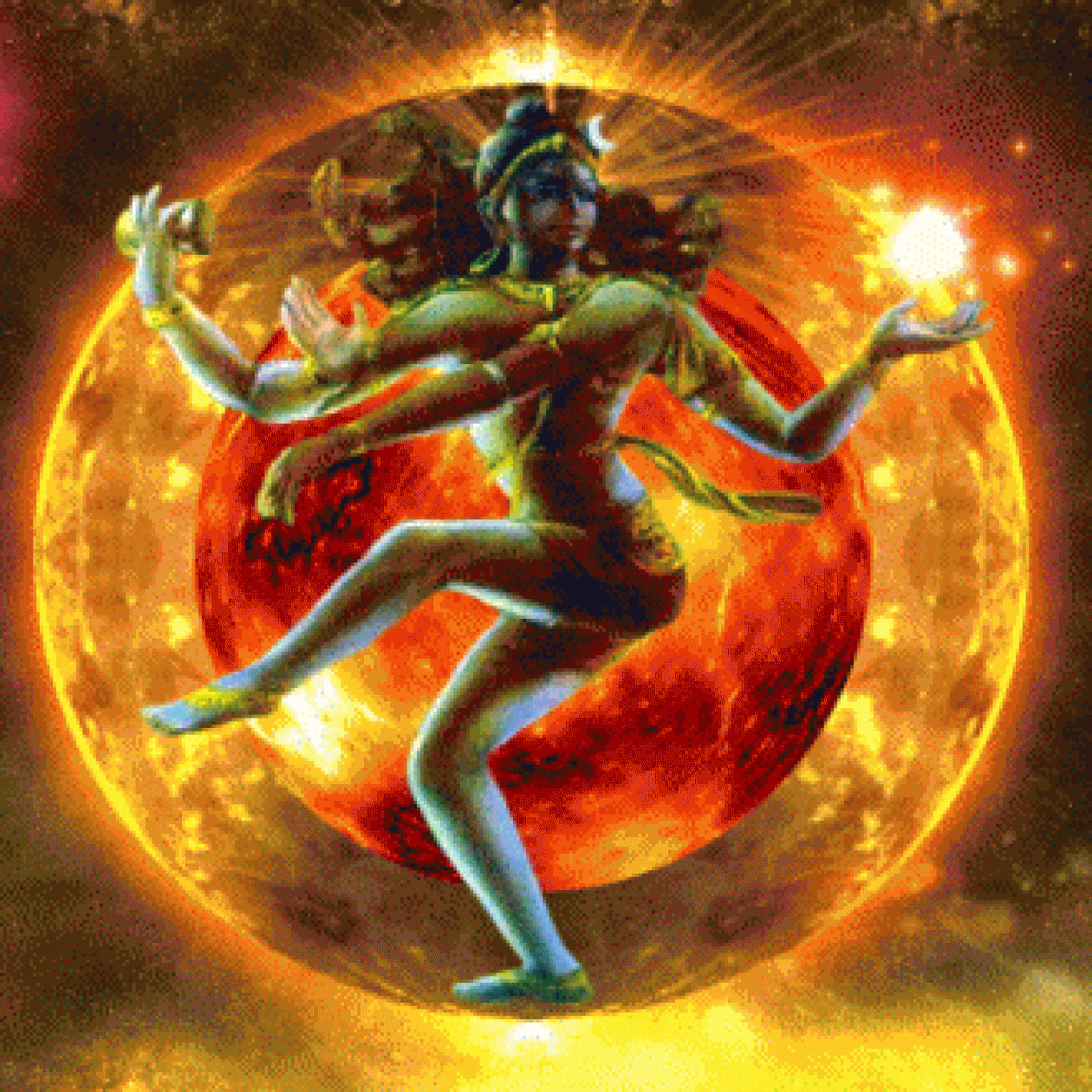
Bharat ,where creation in earth started. A seed place.
Hindu History
The many facets of Indian history mirror the Geographical, Racial, Linguistic and Cultural complexities of the vast Indian sub-continent and as such are not very easy to decipher. However, it is abundantly clear that the chain of events extends way back into the pre-historic times..
That the Early Man, was present and thriving in the Indian heartland, is evident from the Cave-paintings of Bhimbetka in Madhya Pradesh. These paintings date from 40,000 BCE (earlier known as BC) and show the antiquity of human existence in this part of the world.
A large amount of information is available through literary evidence of the Hindu Vedas, Persian Avesta, regional literature and assorted accounts of travelers from both East and West throwing ample light on different aspects of early Hindu civilization.
Through the analysis of these literary masterpieces and corroborating them with the evidence unearthed in recent excavations from Rajasthan and Gujarat in India and the North-western region of Pakistan have pushed back origins of ancient Indian civilization by at least three millenia more!
While the proto-cities excavated in Mehrgarh have been dated to around 6500 BCE, discoveries in the Gulf of Cambay, off the coast of Gujarat (where the fabled city of Dwarka was located), have revealed dates corresponding to 7500 BCE which is older than ANY other civilization in the World!
However, recent research carried out by international archaeologists has shed a great deal of light on the origin, course and final disappearance of the mighty river referred to as the ‘Mother of all rivers’ in the Rigveda and can even help date the scriptures to a large extent!
In the article titled {The Riddle of India’s Ancient Past}, the French proto-historian Michel Danino believes there are strong links between the Veda and the Harappan culture.
‘We find statues and seals depicting yogis and yogic postures, we find a Shiva-like deity, worship of a mother-goddess, fire altars, all of which are suggestive of Vedic culture. Harappan symbols include the Trishul, the Swastika, the Conch shell, the Peepal tree, all of which are central to later Indian culture. The Rig-Veda itself is full of references to fortified cities and towns, to oceans, sailing, trade and industry, all of which are found in the Harappan civilization.’
Vedic altars found in these sites re-affirm that the culture followed in these sites extending from Pakistan-Iran border in the West to Uttar Pradesh in the East; and Kashmir in the North to Godavari in the South was a part of Vedic culture.
Similarly, thoughts are echoed by David Frawley, the director of the American Institute of Vedic Studies, in the article {The Myth of Aryan Invasion},
‘The term ‘Destroyers of cities’ was used to disregard the Vedic as a primitive non-urban culture that destroys cities and urban civilization. However, there are also many verses in the ‘Rig Veda’ that speak of the Aryans as having having cities of their own and being protected by cities upto a hundred in number.
Destruction of cities also happens in modern wars; this does not make those who do this nomads. The idea of Vedic culture as destroying but not building the cities is based upon ignoring what the Vedas actually say about their own cities.’
With the new insights available, even the nomenclature of the Indus Valley Civilization is no more apt as a majority of sites in later excavations fit perfectly along the banks of the newly discovered course of Saraswati. Some scholars have therefore started referring to it as the Indus-Saraswati Civilization.
‘The only remaining testimony to the prestigious civilization of ancient Egypt lay buried in archaeological remains; which meant that inhabitants of the Nile Valley had to wait for Champollion to decipher their hieroglyphics before they could know anything of the beliefs of their ancestors!!
Yet during all this time, Hindu families continued, and still continue today, to venerate the same Vishnu, who is celebrated in the hymns of the Rig Veda!’
Scholarly endeavors like Indian historian and freedom fighter Bal Gangadhar Tilak’s phenomenal work, The Arctic Home in the Vedas; French historian Michel Danino’s outstanding research, The Lost River: On the trail of Saraswati and American Indologist David Frawley’s, The Eternal Tradition-Sanatan Dharma throw new light on ancient Hindu history.
Similarly, the Aitreya Brahman gives the date of 6000 BCE while the Rig Veda has references which throw up time-frames close to 10,000 BCE! One of the Medieval Islamic scholars, Al-biruni, lists many ancient Indian Astronomers who were well versed with the knowledge of both Space-science as well as Mathematics:
Brahmagupta (The first man to use Zero), Aryabhata (The first man to calculate the value of Pie), Bhaskar acharya (The first man to write numbers in decimal system) and Varahamihira (The first astronomer to collate Hindu, Greek and Roman astronomy).
Other visitors like Hiun-Tsang, Fa-Hien and Megasthenes also left extensive accounts of life and its various nuances in ancient India.
The actual dates of origin of the Indian civilization may yet be shrouded in the mists of time, but help has come from a totally unexpected branch of Science – Genetics.
According to the research findings such as MtDNA Haplogroup Study in Indian Peninsula and the Indian Genome Variation project, Indian sub-continent saw the first wave of migration of humanity out of Africa, directly into India about 50,000 years ago! It was from here that waves of people migrated to other parts of Asia as well as the continents of Europe and America!
The results also indicate that there has never been an Aryan Invasion NOR Migration INTO India. Our present genetic diversity evolved as waves of initial settlers in the central regions moved towards both north as well as south of the country, all the time intermixing and migrating to other countries.
{Finding River Saraswati}, {Genetics of the Wandering Indian}, {Rama – The Historical Perspective}, {Krishna – The Historical Enigma}, {Quest for Dwarka} and {India and Bharat},
The new picture that emerges from this mounting data of evidence is of a continuous stream of Civilizational History:
-
Beginning in the Pre-glacial periods around 40,000 BCE when Humans settled in India;
-
Developing into a well-established culture before the onset of the last Ice Age around 20,000 BCE;
-
Continuing the legacy of the bygone Yuga into post-glacial epoch around 10,000 BCE;
-
Flowing onwards to develop into the Indus-Saraswati and Persian civilizations around 8,000 BCE;
-
Experiencing the Golden Age of Ramayan around 7,000 BCE;
-
Witnessing the possibly Nuclear War of Mahabharat around 5,000 BCE;
-
Making the transition from Dvapar to Kaliyug around 3,100 BCE;
-
Finally witnessing the transition of power from Saraswati to Gangetic basin with the latter becoming the new seat of Hindu thought and learning.


HINDUISM
SANSKRIT
- Ashtaadhyaayi part 2
- Ashtaadhyaayi Part 3 in Hindi
- Brihad Dhatu Rupavali
- Download Bhrigu Sutras.pdf
- DOWNLOAD SANSKRIT FREE
- First book of Sanskrit-elementary
- First book of Sanskrit-elementary
- Higher sanskrit grammer
- kashika Nyasa Padamanjari—Sutrapatha Dhatupatha Ganapatha
- Panin Ashtaadhyaayi SootrapaathahYatibodhasahitah
- Panini Ashtadhyayi/mahabhasya – Sanskrit part 2
- Panini astadhyayi part 2
- Panini Mahabhashya
- Samskrita Vakya Prabodh – Swami Dayanand
- Samskrita Vakya Prabodh- Swami Dayanand Saraswati
- sanskrit daily conversation
- Sanskrit dictionary in 3 vol
- Sanskrit elementary -second book.
SANSKRIT LEARNING FREE
- Speak Sanskrit easy way- audio download
- Vachaspatya sanskrit
- Vedic Introduction


Spirituality and meditation


 SANATAN DHARMA
- Vishpala- Ancient medical procedure in India
- Lost Horizon, about the Lost Kingdom of Shangri-La’ पृथ्वी का अद्भूत और दिव्य स्थान-#शंगरीला_घाटी
- Why baby live in womb for 9 months and 9 days
- Ram Setu- a marvel of ancient engineering
- Science in Hinduism
- मुरुदेश्वर, कर्नाटक, Murudeswar, Karnatka, India- Highest Shiva in world
- MUSICAL STEPS IN AIRAVATESHWARA MANDIR; AN EXTRAORDINARY EXAMPLE OF SHILPA SHASTRA
- Untitled
- Sun temple of Multan
- Varahamihir, who predicted water in Mars
Ancient Indian Temples
- शिव का अदृश्यलोक: साल में तीन महीने के लिए प्रकट होने वाला एक मंदिर | KU...
- Surya Temple - Kalkere, Haveri, Karnataka, India- Beutiful sculpture in small villege
- God Ram had advanced Bow and missile as arrow-decoded-
- Sri Lakshmi Narasimha Temple, Javagal – A Forgotten Wonder
- Why baby live in womb for 9 months and 9 days
- बृहदेश्वर मंदिर, Brihdeswar Temple in Thanjavur,Tamilnadu
- Baphuon Temple -Splendid Shiva Temple in Cambodia, earlier Hindu Kingdom
- Death of Hindu
- Untitled
- Sphinx temple of Baluchistan
Donations
If you like, donation button is here.
$5.00
Vedic science
- Vishpala- Ancient medical procedure in India
- Lost Horizon, about the Lost Kingdom of Shangri-La’ पृथ्वी का अद्भूत और दिव्य स्थान-#शंगरीला_घाटी
- Why baby live in womb for 9 months and 9 days
- Ram Setu- a marvel of ancient engineering
- Science in Hinduism
- मुरुदेश्वर, कर्नाटक, Murudeswar, Karnatka, India- Highest Shiva in world
- MUSICAL STEPS IN AIRAVATESHWARA MANDIR; AN EXTRAORDINARY EXAMPLE OF SHILPA SHASTRA
- Untitled
- Sun temple of Multan
- Varahamihir, who predicted water in Mars
Top Posts & Pages





 HINDUISM AND SANATAN DHARMA