NEW DAWN 2032 New era to come
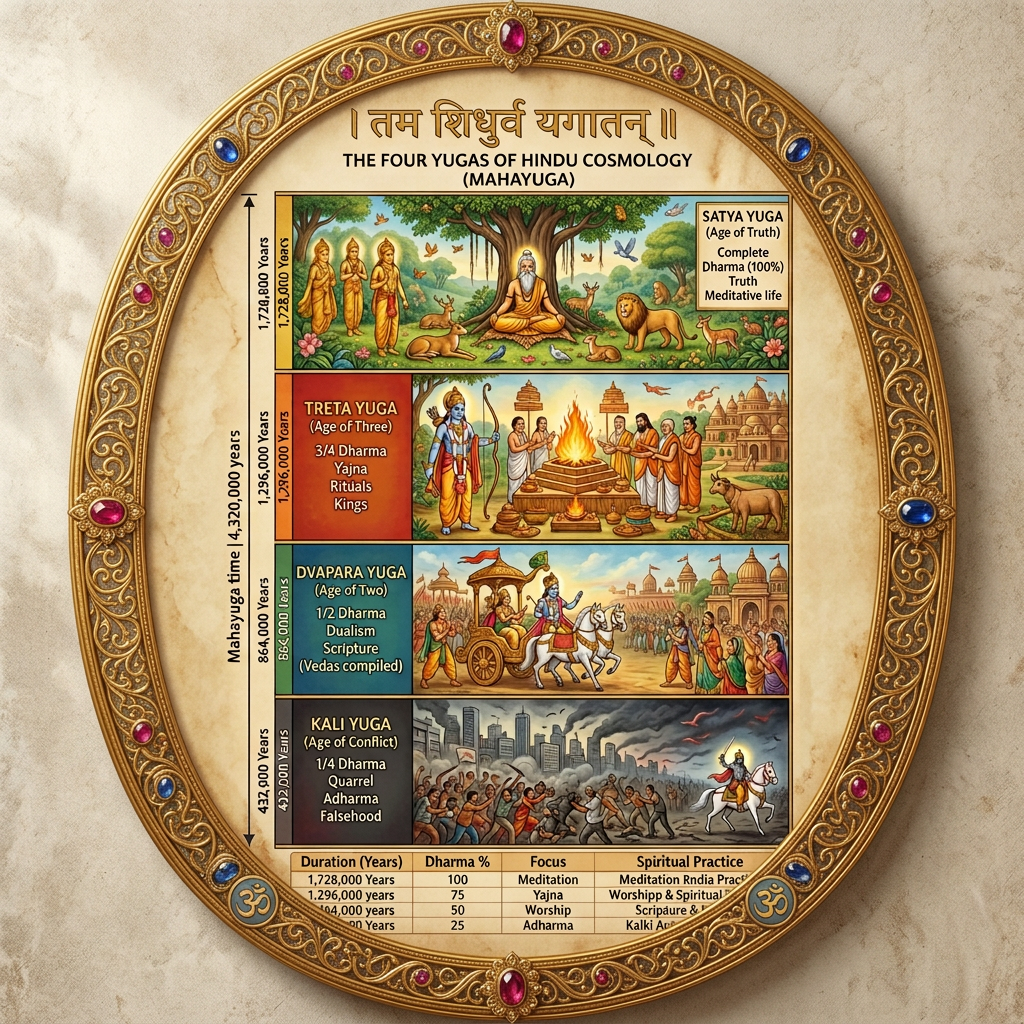
Traditional Hindu scriptures state that Kali Yuga has not passed, with only about 5,100 to 5,500 years of its 432,000-year duration having elapsed since it began in 3102 BCE
According to the Bhavishya Malika interpretation
Some followers believe that Kaliyuga has reached its final stage and that humanity is passing through a Yuga Sandhi—a transition between ages. They associate this period with increasing conflict, natural disasters, moral decline, and the appearance of Lord Kalki.
Some interpretations place the beginning of Satya Yuga around 2032.
Bhavishya Malika Official
+1https://en.bhavishyamalika.com/bhavishya-malika-puran
However, there is an important distinction: in the conventional chronology of Hindu scriptures, Kaliyuga is generally understood to last 432,000 years. Its beginning is traditionally dated to 3102 BCE. Under that chronology, it has not ended.
Therefore, the claim that Kaliyuga has already ended represents a particular interpretation of Bhavishya Malika, rather than the universally accepted Hindu chronology.
Traditional Scriptural View
- Total Duration: According to texts like the Srimad Bhagavatam and Vishnu Purana, Kali Yuga lasts for 432,000 human years.
- Elapsed Time: It is traditionally calculated to have commenced around midnight on February 18, 3102 BCE, marking the departure of Lord Krishna.
- Remaining Time: Roughly 426,000 to 427,000 years remain in the age before the arrival of the Kalki avatar and the reset of the cosmic cycle.
- Golden Sub-Period: Some texts, such as the Brahma Vaivarta Purana, mention a small 10,000-year “golden age” window of devotion inside the early part of Kali Yuga.
Alternative Interpretations
- Shorter Cycle Theories: Some modern spiritual teachers and commentators (such as Sri Yukteshwar or Sadhguru) propose an alternative timeline where a smaller cycle (around 2,592 years or a shorter ascending/descending arc) has elapsed or is transitioning into a different age.
- Alternative Prophecies: Certain regional texts like the Bhavishya Malika are interpreted by some groups as pointing toward near-future transitions (such as around 2032), though these views differ sharply from mainstream Vedic orthodoxy
Why the Timeline is Shortened
- The Potential vs. Actual Lifespan: The text treats 432,000 years as the maximum potential or theoretical lifespan of the age—much like a human with the genetic potential to live to 100 years. [1]
- Destructive Habits of Humanity: Because of severe spiritual failures, corruption, and vice, the era “burns through” its allotted time at an accelerated rate. [1, 2]
- The Math in the Text: According to interpretations of the Bhavishya Malika, human actions deduct roughly 427,000 years from the cycle, leaving only about 5,000 years of active experience before transitioning into a cleansing and renewal phase leading up to Satya Yuga around 2032. [1, 2, 3]
You can read article here also- https://www.newdawnmagazine.com/articles/the-end-of-the-kali-yuga-in-2025-unravelling-the-mysteries-of-the-yuga-cycle . According to above article- The writers of the Puranas, many of which appear to have been written during the first few centuries of the Christian, era, were naturally unwilling to believe that the Kali Yuga had passed away… An attempt was, therefore, made to extend the duration of the Kali Yuga by converting 1,000 (or 1,200) ordinary human years thereof into as many divine years, a single divine year, or a year of the gods, being equal to 360 human years… this solution of the difficulty was universally adopted, and a Kali of 1,200 ordinary years was at once changed, by this ingenious artifice, into a magnificent cycle of as many divine, or 360 × 1200 = 432,000 ordinary years.6
Yuga Cycle of 24,000 Years
However, certain important Sanskrit texts such as the Mahabharata7 and the Laws of Manu,8 which scholars believe were composed earlier than the Puranas, still retain the original value of the Yuga Cycle as 12,000 years. The Mahabharata explicitly mentions that the Yuga Cycle duration is based on the days and nights of human beings. The Zoroastrians also believed in a Cycle of the Ages of 12,000 years’ duration. The Great Year or Perfect Year of the Greeks was variously represented as being of 12,954 years (Cicero) or 10,800 years (Heraclitus) duration. Surely, the Yuga Cycle cannot be of different durations for different cultures.
In the book The Holy Science (1894)Sri Yukteswar clarified that a complete Yuga Cycle takes 24,000 years, and is comprised of an ascending cycle of 12,000 years when virtue gradually increases and a descending cycle of another 12,000 years, in which virtue gradually decreases. Hence, after we complete a 12,000-year descending cycle from Satya Yuga -> Kali Yuga, the sequence reverses itself, and an ascending cycle of 12,000 years begins which goes from Kali Yuga -> Satya Yuga. Yukteswar states that, “Each of these periods of 12,000 years brings a complete change, both externally in the material world, and internally in the intellectual or electric world, and is called one of the Daiva Yugas or Electric Couple.”9
The 24,000-year duration of the complete Yuga Cycle closely approximates the Precessional Year of 25,765 years, which is the time taken by the sun to ‘precess’, i.e. move backwards, through the 12 Zodiac constellations. Interestingly, the Surya Siddhanta specifies a value of 54 arc seconds per year for precession, as against the current value of 50.29 arc seconds per year. This translates into a Precessional Year of exactly 24,000 years! This means that the current observed value of precession may simply be a temporary deviation from the mean.
The concept of an ascending and descending cycle of Yugas is still prevalent among the Buddhists and Jains. The Jains believe that a complete Time Cycle (Kalachakra) has a progressive and a regressive half. During the progressive half of the cycle (Utsarpini), there is a gradual increase in knowledge, happiness, health, ethics, and spirituality, while during the regressive half of the cycle (Avasarpini) there is a gradual reduction in these qualities. These two half cycles follow each other in an unbroken succession for eternity, just like the cycles of day and night or the waxing and waning of the moon.
The ancient Greeks also appear to have believed in an ascending and descending Cycle of Ages. The Greek poet Hesiod (c. 750 BCE – 650 BCE) had given an account of the World Ages in Works and Days, in which he inserted a fifth age called the ‘Age of Heroes’, between the Bronze Age and the Iron Age. In Hesiod’s Cosmos, Jenny Strauss Clay writes:
Drawing on the myth in Plato’s Statesman, Vernant also claimed that the temporal framework of Hesiodic myth, that is, the succession of races, is not linear but cyclical; at the end of the age of iron, which he divides into two, the cycle of races starts again with a new golden age or, more likely, a new age of heroes, as the sequence reverses itself…Vernant himself offers a solution when he remarks that “there is not in reality one age of iron but two types of human existence.”10
This is very interesting. Jean-Pierre Vernant, who is a highly-acclaimed specialist in ancient Greek culture, believes that the Cycle of the Ages reverses itself as per Hesiod’s account. Not only that, he states the Iron Age has two parts, which corresponds to Yukteswar’s interpretation in which the descending Kali Yuga is followed by the ascending Kali Yuga. We can surmise, in this context, that the ‘Age of Heroes’, which immediately followed the Bronze Age in Hesiod’s account, must be the name ascribed by Hesiod to the descending Kali Yuga.
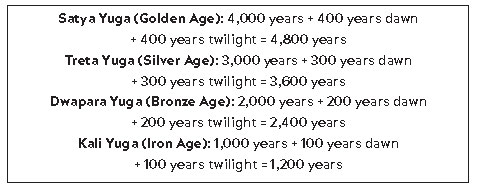
The evidence from different sources supports the notion of a complete Yuga Cycle of 24,000 years, comprised of an ascending and descending cycle of 12,000 years each. This brings us to the question of the relative durations of the different Yugas in the Yuga Cycle, and the transitional periods, which occur at the beginning and end of each Yuga, and are known as Sandhya (dawn) and Sandhyansa (twilight) respectively. The values in the following table are provided in the Sanskrit texts for the duration of the Yugas and their respective dawns and twilights:
Tracking Down the True End Date of Current Kali Yuga
Now this is where it gets interesting. A Saptarshi Era began in 6676 BCE, and another cycle started exactly 3,000 years later in 3676 BCE. But the Saptarshi Cycle is of 2,700 years’ duration. Why did the Saptarshi Era for the Kali Yuga start 3,000 years after the previous cycle? This means a 300-year ‘transitional period’ must have been added to the end of the previous cycle! It clearly proves the hypothesis that the 2,700 year Saptarshi Cycle, along with a 300-year transitional period, was the original calendrical basis of the Yuga Cycle.
If we use the 6676 BCE date as the beginning of the Dwapara Yuga in the descending cycle, and the 2,700 year Saptarshi Cycle along with a 300-year transitional period as the basis for the Yuga Cycle, then the entire timeline of the Yuga Cycle is unravelled.
This Yuga Cycle timeline takes the beginning of the Golden Age to 12676 BCE, more than 14,500 years before present, when the Great Bear was in the Shravana nakshatra (the Great Bear will advance by 3 nakshatras in every Yuga because of the 300-year transitional period). This agrees very well with the Indian tradition, since the Mahabharata mentions that in the ancient tradition the Shravana nakshatra was given the first place in the nakshatra cycle.
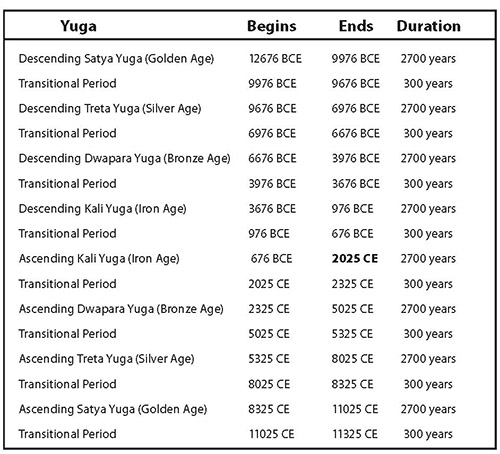
this interpretation, the Kali Yuga ends in 2025, to be followed by a 300
year transitional period leading up to the Ascending Dwapara Yuga.
The timeline also indicates that the ascending Kali Yuga, which is the current epoch in which we are living, will end in 2025 CE. The full manifestation of the next Yuga – the ascending Dwapara – will take place in 2325 CE, after a transitional period of 300 years. The ascending Dwapara Yuga will then be followed by two more Yugas: the ascending Treta Yuga and the ascending Satya Yuga, which completes the 12,000 year ascending cycle.
The Sanskrit text Brahma-vaivarta Purana describes a dialogue between Lord Krishna and the Goddess Ganges. Here, Krishna says that after 5,000 years of Kali Yuga there will be a dawn of a new Golden Age that lasts for 10,000 years (Text 50, 59). This can be immediately understood in the context of the Yuga Cycle timeline described here. We are now ending the Kali Yuga, nearly 5,700 years since its beginning in 3676 BCE. And the end of the Kali Yuga will be followed by three more Yugas spanning 9,000 years, before the ascending cycle ends.
Archaeological & historical evidence
According to the Yuga Cycle doctrine, the transitional periods between the Yugas are associated with a collapse of civilisations and environmental catastrophes (pralaya), which wipe out virtually every trace of any human civilisation. The new civilisation that emerges in the new Yuga is guided by a few survivors of the cataclysm, who carry with them the technical and spiritual knowledge of the previous epoch. Many ancient sources tell us of the enigmatic group of ‘Seven Sages’ (‘Saptarshi’) who are said to appear at the beginning of every Yuga and promulgate the arts of civilisation. We find them in myths across the world – in Sumeria, India, Polynesia, South America and North America. They possessed infinite wisdom and power, could travel over land and water, and took on various forms at will. The Saptarshi Calendar of ancient India appears to have been based on their periodic appearance at the beginning of every Yuga.
As we shall see, the Yuga Cycle timeline proposed here correlates very strongly with the major cataclysmic events that periodically impact our planet, and with a number of important dates recorded in various ancient calendars and scriptures.
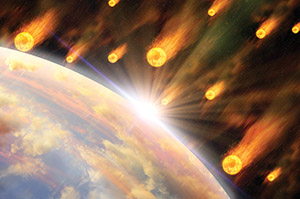
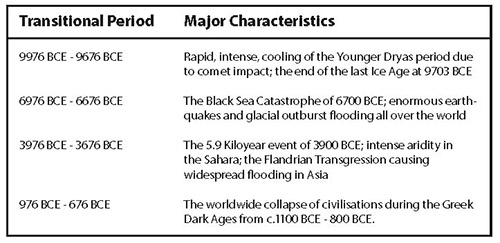
The first transitional period in the 12,000-year descending Yuga Cycle is the 300-year period at the end of the Golden Age from 9976 BCE – 9676 BCE. This is the time when the last Ice Age came to a sudden end; the climate became very warm quite abruptly, and there was a catastrophic global flooding. Many ancient legends refer to this time period. In the Timaeus, Plato tells us of the mythical island of Atlantis which was swallowed up by the sea in a “single day and night of misfortune” in c.9600 BCE. The Zoroastrians believe the world was created by Ahura Mazda at around 9600 BCE, (i.e. 9,000 years before the birth of their prophet Zoroaster in c.600 BCE).
This event has also been recorded in the flood myths of many ancient cultures, which almost uniformly talk of enormous walls of water that submerged the entire land to the highest mountain tops, along with heavy rain, fireballs from the sky, intense cold and long periods of darkness. Archaeologist Bruce Masse of the Los Alamos National Laboratory in New Mexico examined a sample of 175 flood myths from different cultures around the world and concluded that the environmental aspects described in these events, which is also consistent with the archaeological and geophysical data, could have only been precipitated by a destructive, deep-water, oceanic comet impact.21
In recent years, a team of international scientists found compelling evidence that the Earth was bombarded by multiple fragments of a giant comet nearly 12,800 years ago, triggering the start of a rapid and intense cooling period called Younger Dryas, which lasted for nearly 1,200 years till c.9700 BCE. The force of the comet impact, combined with the vicious cold snap that followed, brought about the extinction of a large number of North American megafauna including woolly mammoths and giant ground sloths, and ended a prehistoric civilisation called the Clovis culture – the first human inhabitants of the New World.22
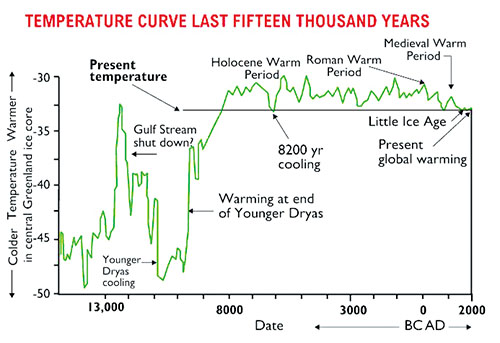
The Younger Dryas ended as abruptly as it started, for reasons not fully understood. Geologists from the Niels Bohr Institute (NBI) in Copenhagen studied the Greenland ice core data and concluded that the Ice Age ended exactly in 9703 BCE. Researcher Jorgen Peder Steffensen said that, “in the transition from the ice age to our current warm, interglacial period the climate shift is so sudden that it is as if a button was pressed.”23 The 9703 BCE date for the sudden climate shift falls within the 300-year transitional period at the end of the Golden Age from 9976 BCE – 9676 BCE, and as such it provides the first important validation of the Yuga Cycle timeline identified here.
Black Sea Catastrophe & Global Floods
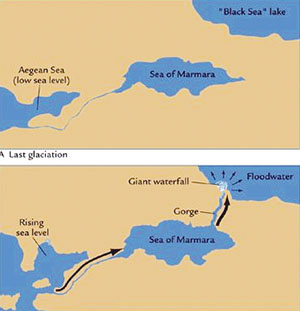
The 300-year transitional period between the Treta Yuga (Silver Age) and the Dwapara Yuga (Bronze Age) from 6976 BCE – 6676 BCE also coincides with a significant environmental event – the Black Sea Catastrophe – recently dated to 6700 BCE. The Black Sea once used to be a freshwater lake. That is, until the Mediterranean Sea, swollen with melted glacial waters, breached a natural dam, and cut through the narrow Bosphorous Strait, catastrophically flooding the Black Sea. This raised the water levels of the Black Sea by several hundred feet, flooded more than 60,000 square miles of land, and significantly expanded the Black Sea shoreline (by around 30%).24 This event fundamentally changed the course of civilisation in Southeastern Europe and western Anatolia. Geologists Bill Ryan and Walter Pitman of Lamont-Doherty Earth Observatory in New York, who first proposed the Black Sea Catastrophe hypothesis, have gone to the extent of comparing it to Noah’s Flood.
Similar major flooding events took place in many parts of the world, as massive glacial lakes, swelled by the waters of the melting ice, breached their ice barriers, and rushed into the surrounding areas. Sometime between 6900 BCE – 6200 BCE the Laurentide ice-sheet disintegrated in the Hudson Bay and an enormous quantity of glacial waters from the inland Lake Agassiz/Ojibway discharged into the Labrador Sea. This was possibly the “single largest flood of the Quaternary Period,” which may have single-handedly raised the global sea level by half a meter.25 The period between 7000 BCE – 6000 BCE was also characterised by the occurrences of gigantic earthquakes in Europe. In northern Sweden, some of these earthquakes caused ‘waves on the ground’, 10 metres high, referred to as ‘rock tsunamis’. It is possible that the global chain of cataclysmic events during this transitional period may have been triggered by a single underlying cause, which we are yet to find out.
The transitional period between the Dwapara Yuga and Kali Yuga, from 3976 BCE – 3676 BCE, was again marked by a series of environmental cataclysms, whose exact nature remains a mystery. It is referred to in geology as the 5.9 kiloyear event, and is considered one of the most intense aridification events during the Holocene period. It occurred around 3900 BCE, ending the Neolithic Sub-pluvial and initiated the most recent desiccation of the Sahara Desert. At the same time, between 4000 BCE – 3500 BCE, the coastal plains of Sumer experienced severe flooding, which “was the local effect of a worldwide episode of rapid, relatively short-term flooding known as the Flandrian Transgression – which had a significant impact not only along the shores of the Gulf but in many other parts of Asia as well.”26 This catastrophic flooding event led to the end of the Ubaid period in Mesopotamia, and triggered a worldwide migration to river valleys. Soon afterwards, we find the emergence of the first river valley settlements in Egypt, Mesopotamia and the Indus Valley in c. 3500 BCE.
This transitional period between the Yugas is also recorded in ancient calendars. For a very long time there was a prevalent belief in the Western world that the world was created in 4004 BCE. This date comes to us from the genealogies of the Old Testament. The date is just 28 years prior to the end of the Dwapara and the beginning of the transitional period. The year of world creation in the Jewish religious calendar is 3761 BCE, which is in the middle of the transitional period.
Greek Dark Ages & Great Upheavals
As per the ancient traditions, the descending Kali Yuga, which was referred to by Hesiod as the ‘Age of Heroes’, came to an end with the battle fought on the plains of Troy. The Yuga Cycle timeline indicates that the 300-year intervening period between the descending and ascending Kali Yuga extended from 976 BCE – 676 BCE; and very interestingly, this overlaps with the 300-year period from 1100 BCE to 800 BCE which is referred to by historians as the Greek Dark Ages!
Historians regard the Greek Dark Ages as a period of transition from the Late Bronze Age to the Early Iron Age. Robert Drews writes that:
Within a period of forty to fifty years at the end of the thirteenth and the beginning of the twelfth century (c.1200 – 1100 BCE) almost every significant city in the eastern Mediterranean world was destroyed, many of them never to be occupied again.27
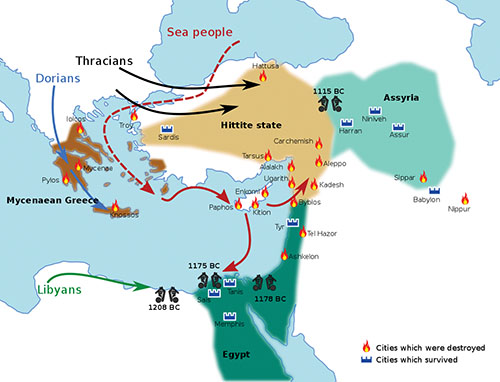
This sudden and violent disruption plunged the entire Near East, North Africa, Caucasus, Aegean, and Balkan regions into a Dark Age that lasted for three hundred years, and was characterised by great upheavals, famine, depopulation, and mass movements of people. Almost every city between Pylos and Gaza was violently destroyed, and many abandoned. The palace economies of Mycenae and Anatolia collapsed, and people lived in isolated, small settlements.
In Egypt, the period from 1070 BCE – 664 BCE is known as the ‘Third Intermediate Period’ during which time Egypt was overrun by foreign rulers. There was political and social disintegration and chaos, accompanied by a series of crippling droughts. In India, the Indus Valley civilisation finally ended around 1000 BCE, and after a gap of nearly 400 years we see the emergence of the 16 Great Kingdoms (Mahajanapadas) in the Gangetic Plains at around 600 BCE. Catastrophe also struck the Olmec civilisation of Mesoamerica at this time. A wholesale destruction of many San Lorenzo monuments occurred in c.950 BCE and the site was abandoned in c.900 BCE. Scholars believe drastic environmental changes may have been responsible for this shift in Olmec centres, with certain important rivers changing course.
When the ascending Kali Yuga began in 676 BCE, much of the knowledge, traditions, and skills from the descending Kali Yuga were forgotten. Possibly in response to this grave social crisis, a number of philosophers and prophets appeared at this time, trying to re-discover the lost wisdom, and spread it amongst the ignorant masses. Among them were Buddha (623 BCE), Thales (624 BCE), Pythagoras (570 BCE), Confucius (551 BCE), Zoroaster (600 BCE), and Mahavir Jain (599 BCE). But much sacred knowledge was irretrievably lost. For instance, the original Vedas were comprised of 1,180 sakhas (i.e. branches), of which only 7 or 8 sakhas (less than 1%) are remembered now. Various errors, omissions, and interpolations also crept into the ancient texts as they were being revised and written down. The mistakes in the Yuga Cycle doctrine were some of them.
The Yuga Cycle timelines proposed here accurately mirrors the worldwide environmental catastrophes that accompany transitional periods between Yugas. Every 2,700 years our planet is impacted by a series of cataclysmic events for a period of a few hundred years, which brings about a total or near total collapse of civilisations across the world. In every case, however, civilisation restarts immediately after the period of destruction. The four key transitional periods, since the end of the Golden Age, are summarised in the above table.
It is evident that the Yuga Cycle used to be tracked using the Saptarshi Calendar. It was of 12,000 years duration, comprised of four Yugas of equal duration of 2,700 years each, separated by transitional periods of 300 years. The complete Yuga Cycle of 24,000 years was comprised of an ascending and descending Yuga cycle, which followed each other for eternity like the cycles of day and night. For the past 2,700 years we have been passing through the ascending Kali Yuga, and this Yuga is coming to an end in 2025.
In accordance with convention, the 300-year transitional period following 2025 can be broken into two periods of 150 years each. The first 150-year period – the ‘Twilight of Kali’ – is when the Kali Yuga structures may collapse due to a combination of wars, environmental catastrophes, and cosmic changes, while the second 150-year period – the ‘Dawn of Dwapara’ – is the time when the spiritually evolved systems and philosophies of the Dwapara Yuga may begin to emerge. It is likely, though, that the twin processes of collapse and emergence will progress simultaneously throughout the entire 300-year transitional period, albeit at different intensities.
The current upswing in tectonic activities and extreme weather phenomena on one hand, and the initial signs of the awakening of a higher consciousness amongst humanity on the other, may be indicative of the fact that the effects of the transitional period are already underway. We need to be aware of these greater cycles of time that govern human civilisation, and the changes that are looming in the horizon.
Now let us see some old resources-
Poet Surdas- AI Overview
“रे मन धीरज क्यों न धरे” संत सूरदासजी के नाम से प्रसिद्ध एक आध्यात्मिक पद (भजन) है, जिसे कलयुग के संकटों और भविष्य से जोड़कर देखा जाता है। [1]
पद का मूल पाठ (भजन)
रे मन धीरज क्यों न धरै।
सम्वत दो हजार के ऊपर ऐसौ योग परै।। (टेक)पूरब पश्चिम उत्तर दक्षिण, चहं दिशि काल परै।
अकाल मृत्यु जग माहीं व्यापै, प्रजा बहुत मरै।। [1]स्वर्ण फल बन पृथ्वी फलै, धर्म की बेलि बढ़ै।
सहस्र बरस लगि सतयुग व्यापै, सुख की दशा फिरै।। [1]काल ब्याल से वही बचै, जो गुरु/हंस का ध्यान धरै।
सूरदास हरि की यह लीला, टारे नाहि टरै।। [1]
पद का अर्थ और संदेश
रक्षा का उपाय: अंत में सूरदासजी समझाते हैं कि इस भवसागर या काल के जाल से वही व्यक्ति पार पा सकता है जो सच्चे मन से ईश्वर, गुरु या हंस (आत्मा/परमात्मा) का ध्यान धरता है, क्योंकि प्रभु की यह लीला अटल है। [1]
समय का संकेत: इस पद में ‘संवत 2000’ (विक्रम संवत) के बाद के कठिन समय और चारों तरफ विपत्तियों या अकाल मृत्यु के बढ़ने का जिक्र है। [1]
धर्म और सत्य का उदय: इसमें यह भी कहा गया है कि कठिन परिस्थितियों के बीच धर्म का प्रसार होगा और कुछ समय के लिए सुख-शांति व सतयुग जैसा वातावरण महसूस होगा। [1]
Garg Samhita- https://dn721708.ca.archive.org/0/items/garga-samhita_202407/Garga%20Samhita.pdf
“Abdāś catuḥsahasrāṇi kalau pañca śatāni ca।
Gate girivare hi Śrīnāthaḥ prādurbhaviṣyati॥”– Garga Samhita (Ashwamegha Khandam, Verse 29, Chapter – 62)
That is, after 4,000 years of Kaliyuga, 400 years after its sandhya time, Lord Mahavishnu (Srinath) will incarnate on earth and alleviate the burden of sins.
This means that when we add 4000 years of Kaliyuga and its tenth part at the start and end, i.e., (4000 + 400 + 400), the total will be 4800 years. After this, it will end, and the Kalki Avatar will incarnate.
Kaliyuga has already ended, and we are in the transformation phase.
Now let us read a complete book which you can download from this link and it is also available in Amazon.com to buy
So we are in World War 3 already and none of wars are going to stop but keep on adding. It is already started with Russia and Ukrain war 5 years ago and now added Middle east war, now war has added Turkey, Pakistan and Saudi Arab also, including Israel and USA with Iran. India is already had war last year with Pakistan and it is still on. Next will be war reaching to Mecca and then Europe, NATO and United NATIONS WILL be divided and would not exist. Then war will go to Taiwan and then when end is coming in 2023, it will be reaching as finale in Orisa, India and we will see islamic countries and China attacking to India and then Russia and Japan to help India and finally GOD “KALI” Will emerge and finish war , dismantling China and limiting USA to a minor country and then for many hundres years SATYUGA will come.


HINDUISM
SANSKRIT
- Ashtaadhyaayi part 2
- Ashtaadhyaayi Part 3 in Hindi
- Brihad Dhatu Rupavali
- Download Bhrigu Sutras.pdf
- DOWNLOAD SANSKRIT FREE
- First book of Sanskrit-elementary
- First book of Sanskrit-elementary
- Higher sanskrit grammer
- kashika Nyasa Padamanjari—Sutrapatha Dhatupatha Ganapatha
- Panin Ashtaadhyaayi SootrapaathahYatibodhasahitah
- Panini Ashtadhyayi/mahabhasya – Sanskrit part 2
- Panini astadhyayi part 2
- Panini Mahabhashya
- Samskrita Vakya Prabodh – Swami Dayanand
- Samskrita Vakya Prabodh- Swami Dayanand Saraswati
- sanskrit daily conversation
- Sanskrit dictionary in 3 vol
- Sanskrit elementary -second book.
SANSKRIT LEARNING FREE
- Speak Sanskrit easy way- audio download
- Vachaspatya sanskrit
- Vedic Introduction


Spirituality and meditation


 SANATAN DHARMA
- Vishpala- Ancient medical procedure in India
- Lost Horizon, about the Lost Kingdom of Shangri-La’ पृथ्वी का अद्भूत और दिव्य स्थान-#शंगरीला_घाटी
- Why baby live in womb for 9 months and 9 days
- Ram Setu- a marvel of ancient engineering
- Science in Hinduism
- मुरुदेश्वर, कर्नाटक, Murudeswar, Karnatka, India- Highest Shiva in world
- MUSICAL STEPS IN AIRAVATESHWARA MANDIR; AN EXTRAORDINARY EXAMPLE OF SHILPA SHASTRA
- Untitled
- Sun temple of Multan
- Varahamihir, who predicted water in Mars
Ancient Indian Temples
- शिव का अदृश्यलोक: साल में तीन महीने के लिए प्रकट होने वाला एक मंदिर | KU...
- Surya Temple - Kalkere, Haveri, Karnataka, India- Beutiful sculpture in small villege
- God Ram had advanced Bow and missile as arrow-decoded-
- Sri Lakshmi Narasimha Temple, Javagal – A Forgotten Wonder
- Why baby live in womb for 9 months and 9 days
- बृहदेश्वर मंदिर, Brihdeswar Temple in Thanjavur,Tamilnadu
- Baphuon Temple -Splendid Shiva Temple in Cambodia, earlier Hindu Kingdom
- Death of Hindu
- Untitled
- Sphinx temple of Baluchistan
Donations
If you like, donation button is here.
$5.00
Vedic science
- Vishpala- Ancient medical procedure in India
- Lost Horizon, about the Lost Kingdom of Shangri-La’ पृथ्वी का अद्भूत और दिव्य स्थान-#शंगरीला_घाटी
- Why baby live in womb for 9 months and 9 days
- Ram Setu- a marvel of ancient engineering
- Science in Hinduism
- मुरुदेश्वर, कर्नाटक, Murudeswar, Karnatka, India- Highest Shiva in world
- MUSICAL STEPS IN AIRAVATESHWARA MANDIR; AN EXTRAORDINARY EXAMPLE OF SHILPA SHASTRA
- Untitled
- Sun temple of Multan
- Varahamihir, who predicted water in Mars
Top Posts & Pages